
Architecture
This page provides a technical overview of the Controller smart contract for developers who need to understand the on-chain mechanisms. For user-facing documentation, see Sessions and Signer Management.
Account Model
The Controller is a smart contract wallet with support for multiple owners and flexible signer types.
Components
The account is built from modular components:
| Component | Purpose |
|---|---|
| multiple_owners | Manages account owners (add/remove signers) |
| session | Session-based transaction authorization |
| outside_execution | Meta-transactions via SNIP-9 |
| external_owners | External contract-based ownership |
| delegate_account | Account delegation support |
Owner Management
Owners are stored by their GUID (a hash identifying the signer). Adding a new owner requires a signature from the new signer to prevent accidental misconfiguration.
fn add_owner(owner: Signer, signature: SignerSignature)
fn remove_owner(owner: Signer)
fn is_owner(owner_guid: felt252) -> boolSigner Types
The Controller supports six cryptographic signature schemes:
| Type | Description | GUID Calculation |
|---|---|---|
| Starknet | Native Starknet curve (most gas-efficient) | poseidon('Starknet Signer', pubkey) |
| Secp256k1 | Ethereum-compatible curve | poseidon('Secp256k1 Signer', pubkey_hash) |
| Secp256r1 | Hardware security module support | poseidon('Secp256r1 Signer', pubkey.low, pubkey.high) |
| Eip191 | Ethereum personal signatures | poseidon('Eip191 Signer', eth_address) |
| Webauthn | passkey support for browsers/OS | poseidon('Webauthn Signer', origin.len(), ...origin, rp_id_hash, pubkey) |
| SIWS | Sign-In With Solana (Ed25519) | poseidon('SIWS Signer', pubkey) |
Each signer is uniquely identified by a GUID (hash of the signer data).
When a signer is added, a SignerLinked event is emitted with the GUID and full signer data.
Sessions (On-Chain)
Sessions allow dapps to submit transactions on behalf of users without per-transaction approval.
Session Structure
struct Session {
expires_at: u64, // Expiration timestamp
allowed_policies_root: felt252, // Merkle root of allowed methods
metadata_hash: felt252, // Hash of session metadata JSON
session_key_guid: felt252, // GUID of the session key
guardian_key_guid: felt252, // GUID of the guardian key (optional)
}How It Works
- Dapp generates a session key pair
- User signs an off-chain message with session parameters
- Dapp submits transactions using a
SessionTokencontaining:- The session data
- Session key signature over
poseidon(tx_hash, session_hash) - Guardian signature (if guardian key is set)
- Merkle proofs for each call
Session Token Format
Transactions using sessions must have signatures starting with the magic value 'session-token'.
Verification
On-chain checks:- Session expiration (
expires_at > block_timestamp) - Session not revoked
- Session key signature validity
- Guardian signature validity (if
guardian_key_guid != 0) - Merkle proofs for each call against
allowed_policies_root
Session Management
fn revoke_session(session_hash: felt252)
fn register_session(session: Session, guid_or_address: felt252)
fn is_session_revoked(session_hash: felt252) -> bool
fn is_session_registered(session_hash: felt252, guid_or_address: felt252) -> boolSession Caching
Sessions can cache the authorization signature to reduce transaction costs.
Set cache_authorization: true in the session token to enable this.
Subsequent transactions can then bypass authorization signature verification.
Wildcard Policies
Sessions can use 'wildcard-policy' as the allowed_policies_root to allow any method call, bypassing policy checks.
Auth Flows
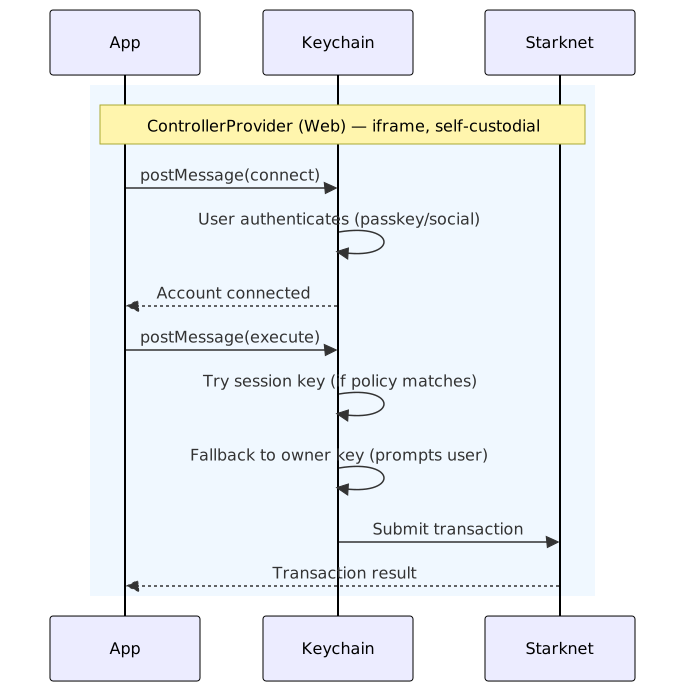
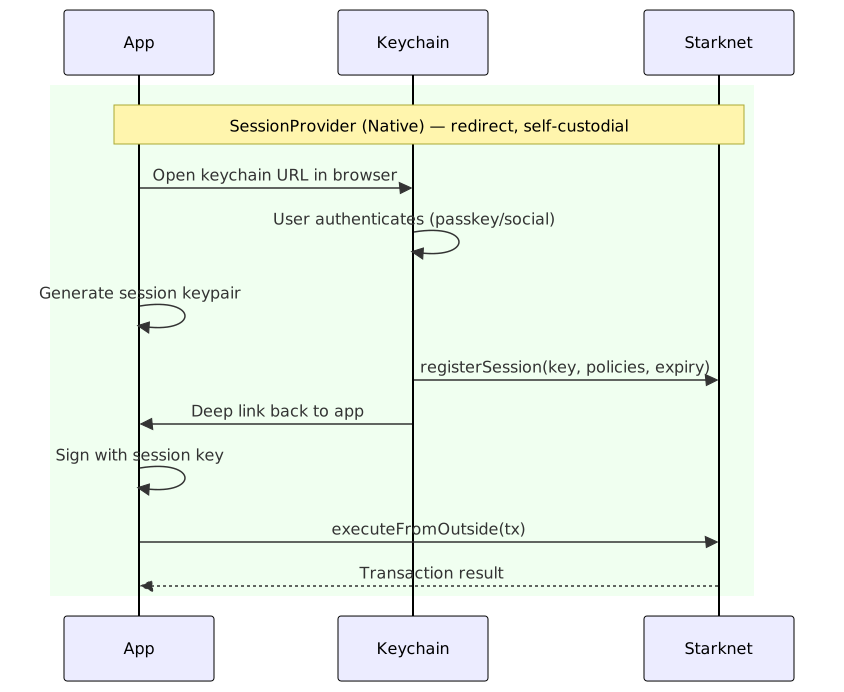
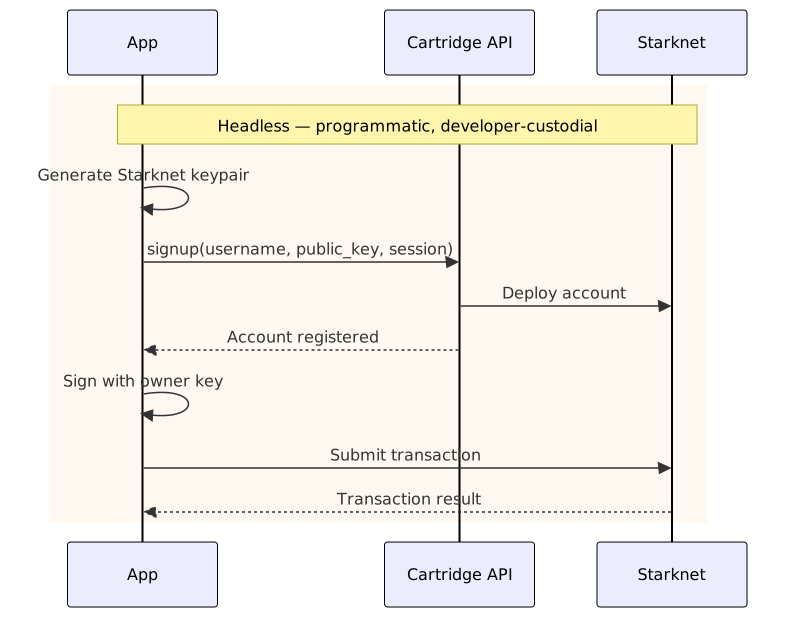
The following diagrams show how each provider authenticates users and signs transactions.
ControllerProvider
SessionProvider
Headless
Transaction Execution Flow
When you call account.execute() in your application, the Controller SDK determines the best execution path based on your session configuration and fee source settings.
Execution Paths
The SDK supports two primary execution methods:
| Method | Description | Use Case |
|---|---|---|
| Regular Execute | Standard Starknet transaction signed by the account | User pays gas fees |
| Execute From Outside | Meta-transaction via SNIP-9 | paymaster-sponsored (gasless) transactions |
How Paymastered Transactions Work
When using the Cartridge paymaster (the default for session-based transactions), your account.execute() call is automatically converted into a meta-transaction:
account.execute(calls)
└── trySessionExecute(calls, feeSource)
└── executeFromOutsideV3(calls, feeSource)
└── cartridge_addExecuteOutsideTransaction (RPC)
└── paymaster submits transaction on-chainThe SDK:
- Validates the session is active and session policies match
- Constructs an
OutsideExecutionmessage with a 10-minute validity window - Signs the message with the session key
- Sends the signed payload to Cartridge's paymaster service
- The paymaster submits the transaction onchain and pays gas fees
If the paymaster is unavailable (e.g., on local Katana), the SDK falls back to regular execution where the user pays fees.
Developer Experience
Game developers don't need to call executeFromOutside directly.
The abstraction is handled entirely by the SDK:
// This is all you need - the SDK handles the rest
const result = await account.execute([
{
contractAddress: GAME_CONTRACT,
entrypoint: "play_card",
calldata: [cardId],
},
]);The SDK automatically:
- Uses
executeFromOutsidewhen paymaster is configured - Falls back to regular execute when paymaster isn't available
- Opens the approval modal if the session is expired or session policies don't match
Outside Execution (SNIP-9)
The Controller implements SNIP-9 for meta-transactions via execute_from_outside_v3.
This allows external contracts or relayers to submit transactions on behalf of the account by providing valid signatures.
fn execute_from_outside_v3(
outside_execution: OutsideExecution,
signature: Span<felt252>
) -> Array<Span<felt252>>The OutsideExecution struct specifies:
caller: Who can submit (or'ANY_CALLER')nonce: Channel-based nonce for replay protectionexecute_after/execute_before: Time window for validitycalls: The calls to execute
For more details on outside execution, see the Starknet.js documentation.
Recovery (Threshold-Based)
Recovery is implemented as a separate component (threshold_recovery_component) for accounts with multiple signers.
When enabled, threshold - 1 signers can initiate recovery to replace a signer.
Escape Flow
- Trigger:
threshold - 1signers calltrigger_escapewith target and new signer - Wait: Security period must elapse (configurable)
- Execute:
threshold - 1signers callexecute_escapeto complete - Expiry: If not executed within expiry period, escape expires
Configuration
fn toggle_escape(is_enabled: bool, security_period: u64, expiry_period: u64)
fn get_escape_enabled() -> EscapeEnabled
fn get_escape() -> (Escape, EscapeStatus)Escape States
| Status | Description |
|---|---|
None | No escape triggered |
NotReady | Escape triggered, waiting for security period |
Ready | Security period elapsed, can be executed |
Expired | Execution window passed, must cancel or re-trigger |
Override Rules
A new escape can override an existing one only if it targets a signer with lower priority in the signer list.
Upgrades
The account can be upgraded via the standard OpenZeppelin upgrade function, requiring owner authorization.
fn upgrade(new_class_hash: ClassHash)Source Code
For full implementation details, see the controller-cairo repository.